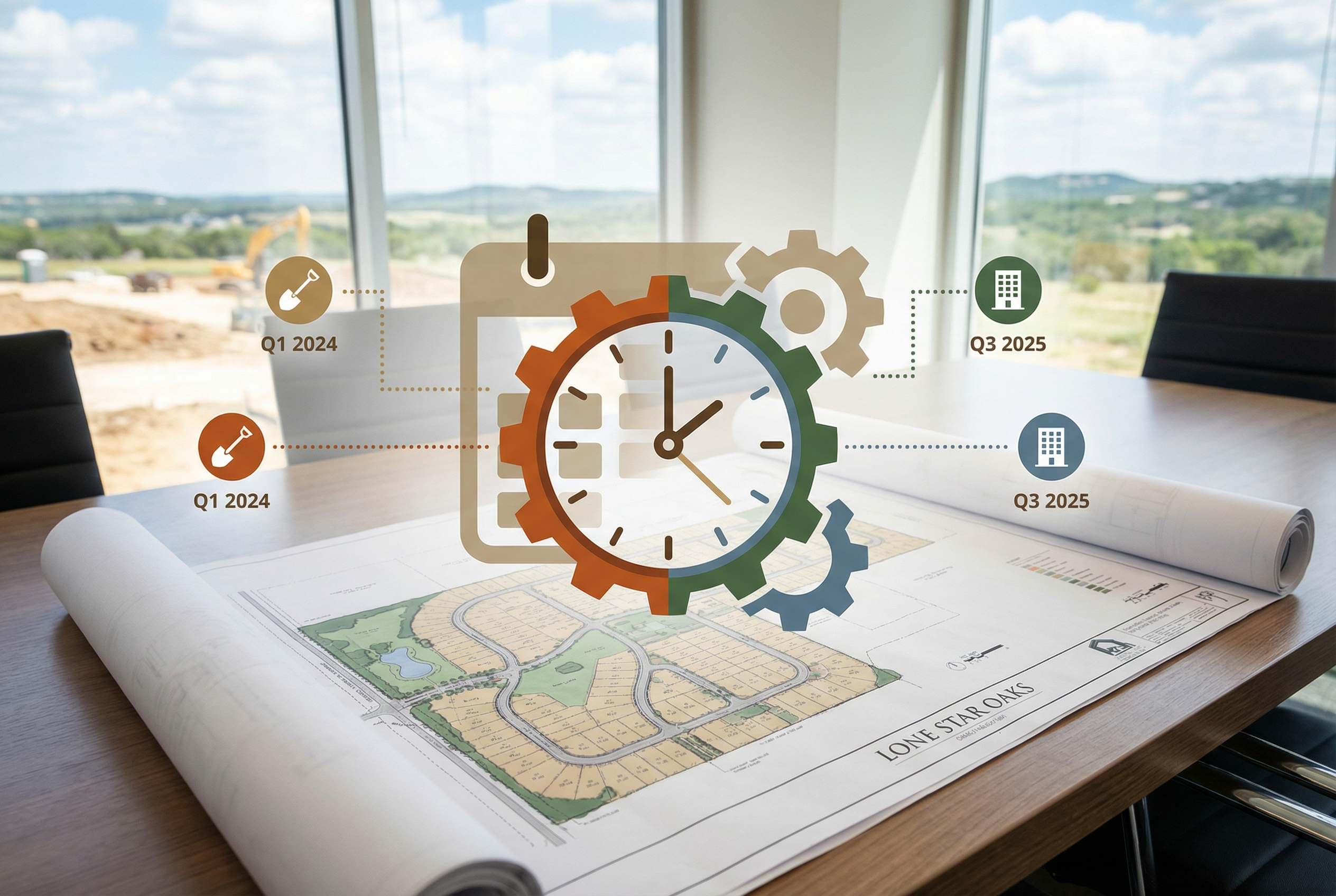
One of the most common questions North Texas landowners ask when considering a land entitlement partnership is: "How long does this actually take?" It's a fair question, and the honest answer is that timelines vary significantly depending on the jurisdiction, property characteristics, and scope of the proposed development.
Understanding the entitlement timeline is critical for making informed decisions about your land. Whether you're comparing a quick cash sale against a structured partnership, or simply trying to understand what the entitlement process involves, this guide breaks down each phase so you know exactly what to expect.
Why Entitlement Takes Time
Land entitlement is not a single event—it's a series of interconnected approvals that must be obtained from multiple government agencies and departments. Each approval builds on the previous one, and many cannot proceed in parallel. The process involves feasibility analysis, conceptual design, engineering, public input, and formal government action.
In Texas, the entitlement process is governed by a combination of state law and local municipal ordinances. Each city, county, and special district has its own procedures, timelines, and requirements. A project in Frisco may move at a very different pace than one in Denton or Collin County. Understanding these local nuances is one of the key advantages that experienced development partners bring to the table.
The good news is that the timeline is predictable once you understand the phases. While delays can occur, most projects follow a well-established sequence of steps that experienced teams can navigate efficiently.
Phase 1: Feasibility and Due Diligence (30–90 Days)
The first phase of the entitlement process focuses on determining whether the project is viable before committing significant resources. This is the most important phase from a risk management perspective, because it identifies potential deal-breakers early.
During feasibility, the development team evaluates several critical factors. They assess road access and frontage to determine how the site connects to existing infrastructure. They research utility availability—water, sewer, and electrical capacity—to understand what infrastructure investments may be needed. They analyze topography, drainage patterns, and floodplain designations to identify any physical constraints on development.
The team also reviews the municipality's comprehensive plan and current zoning to understand what types of development are likely to be approved. They may conduct preliminary environmental assessments and research any deed restrictions, easements, or title issues that could affect the project.
This phase typically costs $10,000–$50,000 in professional fees—all funded by the development partner in a structured partnership. If the feasibility analysis reveals that the project isn't viable, the process ends here with no cost to the landowner.
Phase 2: Preliminary Planning and Zoning (3–6 Months)
Once feasibility is confirmed, the project moves into preliminary planning and zoning. This is where the conceptual vision for the development takes shape and begins moving through the municipal approval process.
The development team creates a conceptual site plan showing the proposed layout of lots, roads, open spaces, and amenities. This plan is refined through pre-application meetings with city planning staff, who provide feedback on compliance with local standards and identify any potential issues.
If the property requires rezoning—which is common for raw land being converted to residential or commercial use—the formal zoning application is prepared and submitted during this phase. Rezoning applications typically require public notification, planning commission review, and city council approval. The timeline for this process depends heavily on the municipality's meeting schedule and the complexity of the request.
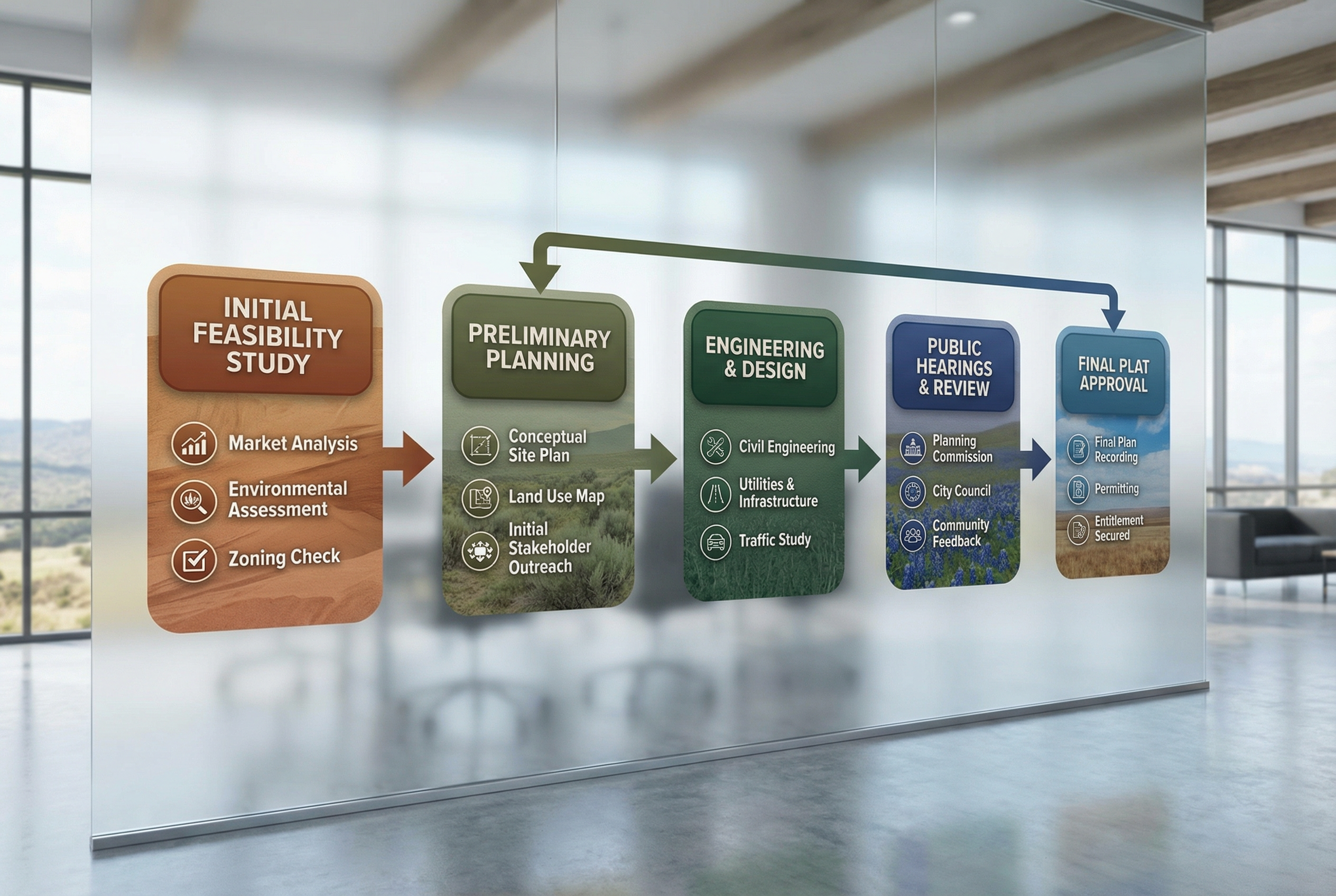
Phase 3: Engineering and Final Approvals (6–12+ Months)
The final and often longest phase involves detailed civil engineering, infrastructure design, and obtaining all remaining approvals needed to record the final plat. This is where the conceptual plan becomes a construction-ready set of documents.
Civil engineers design the road network, stormwater management systems, water and sewer infrastructure, and grading plans. These designs must comply with the municipality's engineering standards and are reviewed by multiple city departments—often requiring several rounds of revisions before approval.
During this phase, the development team also secures any remaining permits and approvals, including environmental permits, utility agreements, and drainage district approvals. The final plat—the legal document that creates the individual lots—is prepared, reviewed, and ultimately recorded with the county.
Once the final plat is recorded and all engineering approvals are in place, the land is officially entitled. At this point, the property has been transformed from raw land into development-ready lots that builders are willing to pay a significant premium for—often two to three times the raw land value.
Factors That Can Delay the Timeline
While the phases described above represent the typical sequence, several factors can extend the timeline beyond initial projections. Understanding these potential delays helps set realistic expectations.
Environmental Issues
Environmental constraints are among the most common causes of entitlement delays. Wetlands, endangered species habitats, contaminated soils, and floodplain designations can all require additional studies, mitigation plans, and agency approvals. In some cases, environmental issues discovered during the process can fundamentally change the project's scope or feasibility.
The Army Corps of Engineers, Texas Commission on Environmental Quality, and other agencies may need to review and approve aspects of the project. These federal and state reviews operate on their own timelines and cannot be accelerated by the local municipality.
Community Opposition
Public opposition to development projects is a reality in many North Texas communities, particularly in areas experiencing rapid growth. Neighbors may object to increased traffic, changes in neighborhood character, or concerns about property values. Organized opposition can lead to project redesigns, additional public meetings, and sometimes denial of applications.
Experienced development teams mitigate this risk through proactive community engagement, thoughtful project design, and strategic communication. However, even well-managed projects can face delays when community concerns require additional time to address.
Municipal Capacity and Scheduling
Many rapidly growing North Texas municipalities are processing a high volume of development applications simultaneously. Staff review times, meeting schedules, and inspection availability can all affect the pace of approvals. Some cities have implemented expedited review processes for certain types of projects, while others maintain strict first-come, first-served queues.
Why the Timeline Matters for Landowners
Understanding the entitlement timeline is essential for evaluating your options as a landowner. If you're considering a cash sale, you're accepting today's raw land price and allowing the buyer to capture all the value created through entitlement. If you're considering a structured partnership, you're investing time—typically 12 to 24 months—in exchange for participating in significantly higher returns.
The key insight is that the timeline represents value creation. Each phase of the entitlement process reduces risk and increases the land's market value. By the time the process is complete, the property is worth substantially more than when it started. In a structured partnership, you participate in that value creation without funding the process yourself.
Start Your Feasibility Review Today
If you own 10 or more acres in the Dallas–Fort Worth area and want to understand the realistic timeline for your specific property, the first step is a feasibility review. Submit your property details and our team will evaluate whether a structured entitlement partnership makes sense—and provide a preliminary timeline based on your property's location, characteristics, and the relevant municipal processes.
There's no cost, no obligation, and no pressure. You'll gain clarity on your options and a realistic understanding of what the entitlement process would look like for your land.