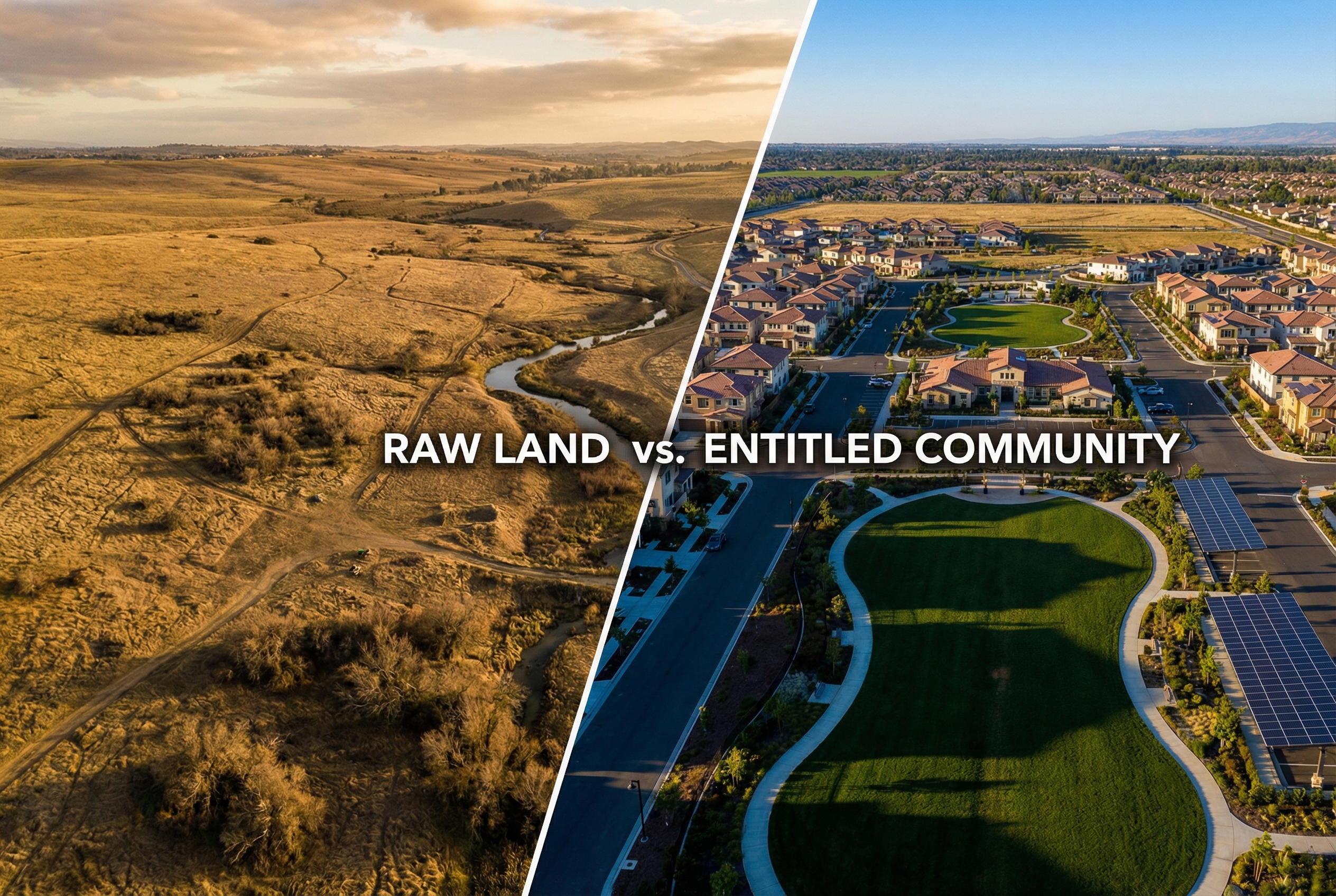
If you own undeveloped land in North Texas, you’re sitting on an asset that could be worth significantly more than what a traditional cash buyer is willing to pay. The difference between what developers offer for raw land and what that same land is worth after entitlement can be staggering—often two to three times the original value.
This guide explains exactly how the land entitlement process works, why it creates so much value, and how structured partnerships allow landowners to capture that upside without funding the process themselves. Whether you own 10 acres or 100, understanding these concepts is the first step toward making an informed decision about your property’s future.
What Land Entitlement Actually Means
Land entitlement is the legal and regulatory process of obtaining all government approvals necessary to develop a piece of raw land. This includes zoning changes, subdivision approvals, utility agreements, environmental clearances, and engineering permits. Until a property is entitled, it exists in a state of uncertainty—developers don’t know what they can build, how much it will cost, or whether the project is even feasible.
The entitlement process removes that uncertainty. Each approval milestone—from initial zoning to final plat—reduces risk and increases the land’s market value. By the time a property is fully entitled, it has transformed from speculative raw land into a development-ready asset with a clear path to construction.
Why Developers Need Entitled Land
Homebuilders and commercial developers prefer to purchase entitled land because it eliminates the most unpredictable phase of the development process. When they buy entitled lots, they know exactly what they can build, what the infrastructure costs will be, and when they can start construction.
This preference creates a significant price premium. Developers will pay substantially more per acre for entitled land than for raw land because they’re buying certainty. The residual land value method that developers use to calculate their offers directly reflects this: the more risk that’s been removed, the higher the land value.
The Value Gap: Raw vs. Entitled Land Value
The financial difference between raw land and entitled land is where the opportunity lies for landowners. Consider a simplified example:
Example: 20-Acre Parcel in North Texas
| Scenario | Value Per Acre | Total Value |
|---|---|---|
| Raw Land (Cash Sale) | $50,000 | $1,000,000 |
| After Zoning Approval | $75,000 | $1,500,000 |
| Fully Entitled | $125,000–$150,000 | $2,500,000–$3,000,000 |
Note: These figures are illustrative. Actual values depend on location, zoning, market conditions, and project specifics.
In this scenario, the landowner who sells raw land for $1 million leaves $1.5–2 million on the table. That’s the value the developer captures by completing the entitlement process. A structured partnership allows the landowner to participate in that value creation.
How Land Development Partnerships Work
A land development partnership is a structured arrangement where a development partner handles the entitlement process at no upfront cost to the landowner. Instead of selling for a one-time cash payment, the landowner enters into an agreement that ties their compensation to the entitled value of the property.
The development partner funds all entitlement expenses—feasibility studies, engineering, zoning applications, legal fees, and municipal costs. In return, the economics are structured so both parties benefit from the increased value. The landowner typically retains ownership during the process and participates in the upside when the entitled land is sold to builders or developers.
This model works because it aligns incentives. The development partner only profits if the entitlement is successful, which means they’re motivated to pursue only viable projects and execute them efficiently. The landowner benefits from professional expertise and capital without risking their own money.
The Entitlement Timeline in North Texas
The entitlement timeline varies significantly depending on the jurisdiction, property characteristics, and scope of the project. In the Dallas–Fort Worth area, a typical timeline might look like this:
- Feasibility and Due Diligence (30–90 days): Initial assessment of the property’s development potential, including environmental, access, and utility analysis.
- Preliminary Planning and Zoning (3–6 months): Conceptual design, pre-application meetings with the city, and formal zoning applications.
- Engineering and Final Approvals (6–12+ months): Detailed civil engineering, public hearings, city council approvals, and final plat recording.
The total process typically ranges from 12 to 24 months, though some projects move faster and others take longer. Factors that can affect the timeline include environmental issues, community opposition, utility availability, and the complexity of the entitlement process in the specific jurisdiction.
Understanding the Risks and Feasibility
Not every piece of land is suitable for development, and not every entitlement effort succeeds. Understanding the risks is essential for making an informed decision. Key factors that determine whether land is developable include:
- Access and road frontage: The property must have practical access to existing road infrastructure.
- Utility availability: Water, sewer, and electrical infrastructure must be accessible or extendable to the site.
- Topography and environmental constraints: Floodplains, wetlands, and steep terrain can limit or prevent development.
- Zoning and future land use plans: The municipality’s comprehensive plan and current zoning must support the intended use.
- Minimum acreage requirements: Most development projects require a minimum of 10 acres to achieve economies of scale.
In a structured partnership, the development partner conducts thorough feasibility analysis before committing resources. This protects both parties—if the land isn’t viable, the process ends early with no cost to the landowner.
Example Scenarios: Cash Sale vs. Partnership
To illustrate the difference, consider two landowners with similar properties who choose different paths:
Scenario A: Cash Sale
- Landowner receives cash offer of $800,000
- Transaction closes in 30–60 days
- Developer entitles the land over 18 months
- Developer sells entitled lots for $2.4 million
- Landowner’s outcome: $800,000
Scenario B: Partnership
- Landowner enters structured partnership
- Development partner funds entitlement ($0 cost to landowner)
- Entitlement completed over 18 months
- Entitled lots sold for $2.4 million
- Landowner’s outcome: $1,600,000–$2,000,000
Note: These scenarios are illustrative. Actual outcomes depend on property specifics, market conditions, and partnership terms.
The difference is substantial. By choosing to partner rather than sell, the landowner in Scenario B earns $800,000–$1.2 million more—without investing any of their own capital. This is the power of capturing entitlement value rather than leaving it for the developer.
Explore Our Complete Guide Library
Each of the following guides dives deeper into a specific aspect of land entitlement, development partnerships, and the decision-making process for North Texas landowners:
Next Steps: Discover Your Land’s Potential
If you own 10 or more acres in the Dallas–Fort Worth area and you’re curious about what your land could be worth after entitlement, the next step is simple. Submit a quick qualification form and our team will evaluate whether a structured partnership makes sense for your property.
There’s no cost, no obligation, and no pressure. If your land is a fit, we’ll outline the potential path forward. If it’s not, we’ll tell you why and suggest alternatives. Either way, you’ll have more information than you started with—and that’s always a good position to be in.