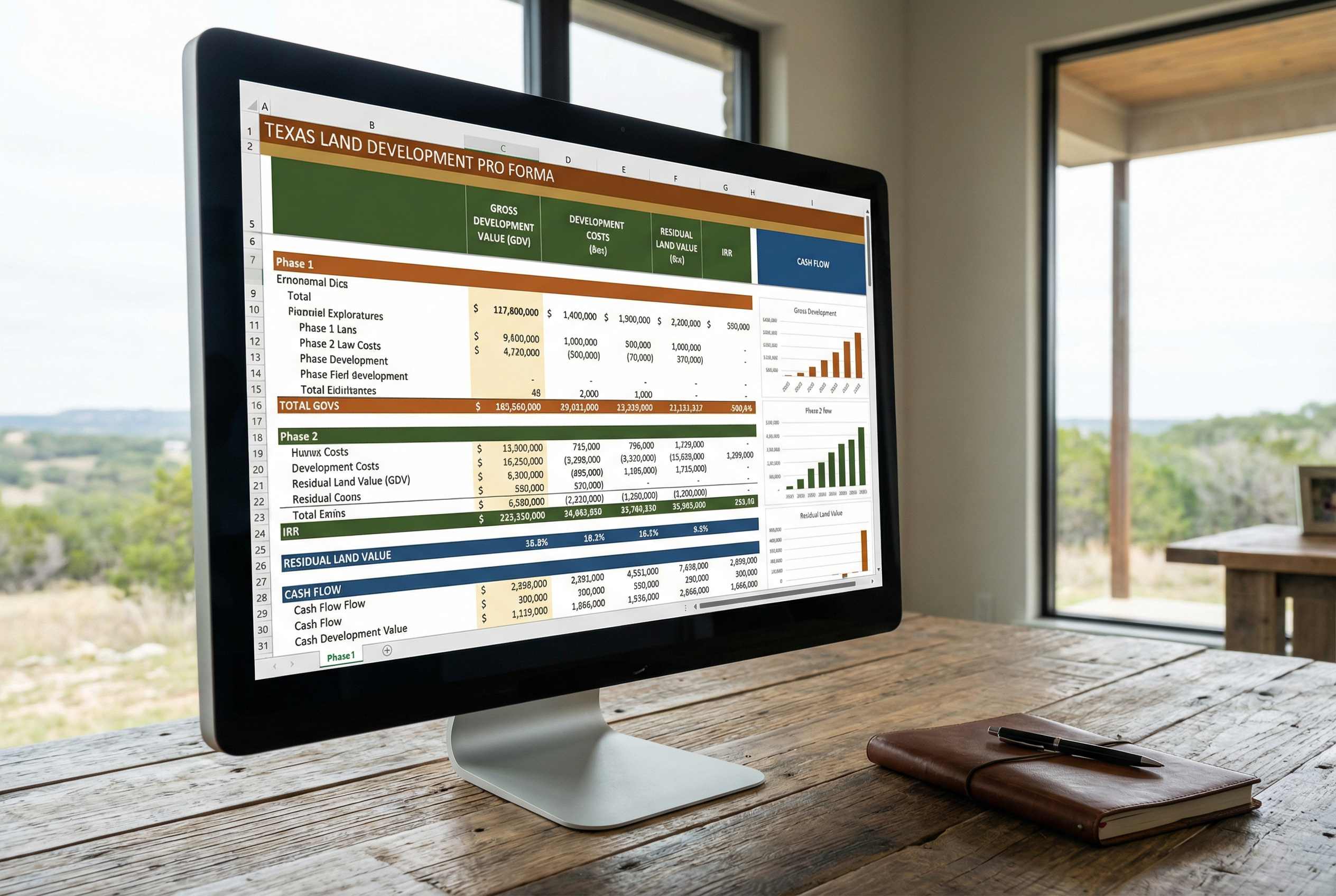
When a developer looks at your property, they don't see a beautiful pasture or a beloved family homestead. They see a complex equation. They see a potential future—a bustling subdivision, a thriving commercial center—and work backward to determine what they can afford to pay you today. For most landowners, this process is a black box, leading to confusion and the nagging feeling that they're leaving money on the table. The truth is, most do.
Understanding the math behind a developer's offer is the first step to maximizing your financial outcome. It’s about shifting your perspective from a simple seller to a knowledgeable partner in the land's transformation. This article will demystify the core valuation method developers use and show you how to leverage this knowledge to your advantage.
The Myth of "Price Per Acre"
The most common question landowners ask is, "What's the price per acre in my area?" While seemingly logical, this is fundamentally the wrong question. Developers don't value land based on a generic per-acre metric. A 10-acre parcel that can be developed into 40 single-family homes is vastly more valuable than a 100-acre parcel that can only support 10 homes due to zoning or environmental constraints. The value isn't in the acreage; it's in the density and use that the land can support.
A developer's offer is not based on what your land is worth today, but on what it *could be worth* after they develop it, minus their costs and profit.
Relying on comparable sales of raw, undeveloped land can be misleading. The neighbor who sold for $50,000 an acre might have sold to a developer who then spent two years and millions of dollars entitling the land, ultimately creating a project where the land value, on paper, was closer to $150,000 per acre. The key is to understand the method they use to arrive at their offer: the Residual Land Value method.
The Residual Land Value Method Explained
The Residual Land Value calculation is the industry standard for determining the acquisition price for development land. It's a "back-of-the-envelope" calculation that becomes increasingly detailed as a project moves forward. The core formula is simple:
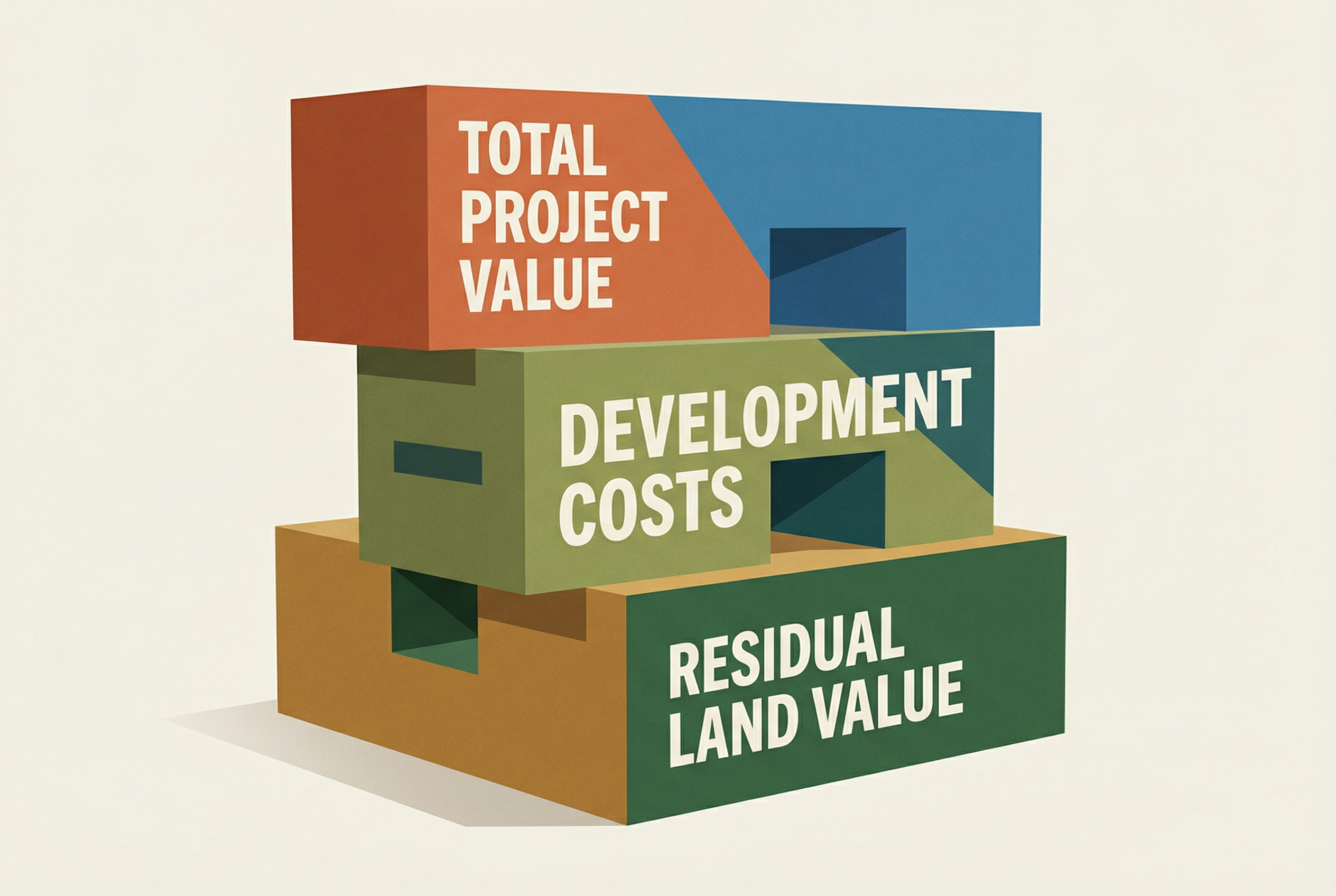
Gross Development Value - Total Costs - Developer's Profit = Residual Land Value
This residual value is the maximum amount a developer can justify paying for your land while still meeting their investment goals. Let's break down each component.
Step 1: Estimating Gross Development Value (GDV)
The GDV is the total revenue the developer expects to generate from selling the completed project. For a residential subdivision, this would be the projected sale price of all finished lots or homes. For a commercial project, it might be the sale price of the building or the capitalized value of its rental income.
To calculate GDV, a developer researches the market to find the final price a homebuyer or commercial tenant will pay. For example, if they believe they can build and sell 100 homes at an average price of $500,000 each, the GDV is $50 million. This is the starting point for the entire valuation.
Step 2: Subtracting Development Costs
This is the largest and most complex part of the equation. Development costs, often called "hard costs" and "soft costs," include everything needed to transform raw land into a finished product.
- Hard Costs: These are the tangible construction expenses. Think earthwork, paving roads, installing water and sewer lines, pouring concrete, and framing buildings.
- Soft Costs: These are the intangible but necessary expenses. This category includes architectural and engineering fees, surveying, legal fees, municipal permit and impact fees, financing costs (interest on loans), marketing expenses, and property taxes during the development period.
- Contingency: Prudent developers add a contingency budget (typically 5-10% of hard and soft costs) to cover unforeseen problems like unexpected soil conditions or delays in approvals.
These costs can easily run into the tens of millions of dollars and require extensive local knowledge to estimate accurately. A developer considering a project in North Texas must understand the specific fee structures in cities like Celina or Denton, the local cost of concrete, and the time it takes to get a plat approved. For more on this, see our guide on what makes land developable.
Step 3: Factoring in Developer Profit
Development is a high-risk, high-reward business. Developers require a significant profit margin to compensate them for the capital they invest and the risks they undertake. This profit is not an afterthought; it's a required line item in their pro forma. A typical target is a 20-25% profit on their total costs. If the total development costs are $35 million, they will factor in a $7 to $8.75 million profit requirement.
Why Entitlement Increases the Residual Value
Now we come to the most critical value driver: entitlement. As we've discussed in our pillar page on land entitlement, this is the legal process of securing zoning, density, and use approvals from a municipality. Comparing raw land vs. entitled land is like comparing a lottery ticket to a certified check.
Without entitlements, the GDV is purely speculative. A developer is "guessing" they can get approval for 100 homes. The costs are uncertain, and the timeline is unknown. This massive uncertainty and risk dramatically lowers the price they are willing to pay. When land is fully entitled, the "what if" becomes a "what is."
Entitlement de-risks the project for the developer, which allows them to pay a significantly higher price for the land because the Gross Development Value is now based on a legal certainty.
When you sell your land with entitlements in place, you are the one who captures the value uplift from that de-risking. You are not selling a risky project but a proven development opportunity. This is the fundamental service Land Partner Group provides: we navigate the complex entitlement process for you, transforming your property's potential value into actual, marketable value.
How to Maximize Your Land's Valuation
Selling raw land directly to a developer is often the path of least resistance, but it almost always leaves significant value on the table. The developer is paid handsomely for taking on the entitlement risk, and that payment comes directly from your pocket in the form of a lower land price.
To truly maximize your return, you must capture the entitlement value yourself. This means partnering with an expert who can manage the process on your behalf. By investing in the planning, engineering, and legal work required to secure entitlements, you change the entire valuation equation. You present a developer with a turnkey project, minimizing their risk and maximizing their confidence, which in turn maximizes the residual value they can and will pay for your land.
This is the smart alternative to a quick, low-value sale. It’s a strategic decision to trade a bit of time for a substantial financial gain. If you are ready to unlock the true potential of your property and step into a more lucrative position in the development process, we can help.
Take the first step towards realizing your land's full potential. Partner with us, and let's transform your property from a raw asset into a high-value, development-ready opportunity.